
Table of Contents
Q What is chronic vocal cord inflammation?
Chronic laryngitis (vocal cord inflammation) is a condition in which repetitive strain from voice use causes chronic inflammation of the vocal cords and surrounding structures, resulting in symptoms such as difficulty producing voice, a tickling sensation in the throat, coughing, and phlegm that persist for three months or more.
The vocal cords are part of an organ called the larynx, located at the level of the Adam's apple. The condition is particularly common in people who use their voice extensively in their work — such as teachers, lecturers, dance instructors, and singers — as well as in people who frequently raise their voice, such as at sporting events, and in women after menopause.
Treatment focuses on reducing the load on the vocal cords and may include oral anti-inflammatory medications, inhalation therapy, injections, and treatment of any underlying infection or allergy.
Q What are the symptoms of vocal cord inflammation?
The most characteristic symptom of chronic vocal cord inflammation is dysphonia (hoarseness) — a rough, strained, or weakened voice. Other symptoms include a tickling sensation in the throat, a burning or irritated feeling, a persistent sense of something in the throat that triggers the urge to cough, and frequent clear phlegm.
When these symptoms persist for three months or more, the condition is referred to as vocal cord inflammation or chronic laryngitis.
Q What causes vocal cord inflammation?
The two most common causes of chronic vocal cord inflammation are viral infection and vocal overuse (overuse of the voice through singing, public speaking, cheering, or similar activities).
In terms of viral infection, influenza and COVID-19 are among the known causes. Acute inflammation triggered by these viruses can persist and become chronic.
Vocal overuse refers to excessive and repeated strain placed on the vocal cords. The vocal cords are a paired structure, and during phonation they repeatedly collide with each other, as well as being subjected to twisting and tensile forces. This repeated mechanical stress triggers the production of inflammatory cytokines within the submucosal layer of the vocal cords, leading to redness, bleeding, increased blood vessel formation, and swelling. Over time, this cycle of repeated injury contributes to the development of vocal cord inflammation and vocal cord polyps.
Additional risk factors for chronic vocal cord inflammation include:
- Vocal overuse
- Viral infection (including COVID-19)
- Air pollution (fine particulate matter such as PM2.5, and yellow dust)
- Smoking
- Excessive alcohol consumption
- Recurrent postnasal drip (from chronic sinusitis or chronic rhinitis, where mucus drips down the back of the throat)
- Recurrent coughing
- Type 1 allergy
- Gastric acid reflux (gastroesophageal reflux disease, which can also affect the vocal cords)
Q What tests are used to diagnose vocal cord inflammation?
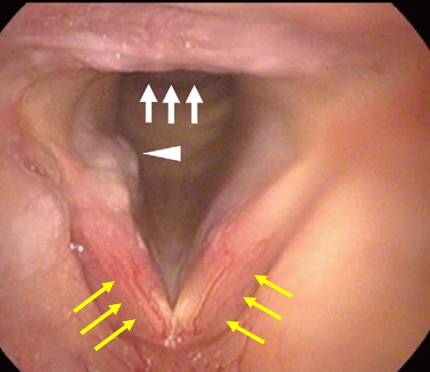
Diagnosis is based on a medical history and endoscopic examination. Endoscopy typically reveals mild redness and swelling across the entire vocal cord surface (indicated by the yellow arrows in the image below).
In cases caused by gastroesophageal reflux or laryngeal allergy, edematous swelling is often also observed in the arytenoid region — the area located posterior to the vocal cords (indicated by the white arrows in the image below) — in addition to the vocal cord inflammation itself.
Q How is vocal cord inflammation treated?
The main approaches to treating chronic vocal cord inflammation are lifestyle guidance and oral medication.
In terms of lifestyle modification, patients whose condition is caused by vocal overuse are advised to rest the voice and reassess their vocal habits and training methods. Alcohol consumption and smoking should be reduced or eliminated. Wearing a mask to avoid inhaling air pollutants such as PM2.5 is recommended, and the use of a humidifier to prevent dryness is also encouraged. Steroid injections may also be used.
In terms of medication, proton pump inhibitors (to suppress gastric acid) are prescribed when gastroesophageal reflux is suspected as a contributing cause, and antihistamines are used when allergy is implicated. Cough suppressants may also be prescribed. Other medications used include corticosteroids, analgesics (such as acetaminophen and ibuprofen), gargles, lozenges, and expectorants (such as carbocisteine).
Q What should be done if vocal cord inflammation does not improve?
A new outpatient catheter-based treatment has recently been developed for chronic, treatment-resistant inflammation.
Q I have had chronic vocal cord inflammation for about a year and various treatments have not helped. Can it be improved?
In chronic vocal cord inflammation, the redness visible in the vocal cord mucosa reflects the presence of abnormal blood vessels, which are a known driver of persistent, difficult-to-resolve inflammation.
Whenever inflammation occurs in the body, abnormal blood vessels invariably form at the site. Inflammatory cells and fluid leak from these vessels, causing the vocal cords to swell. When inflammation becomes prolonged, these abnormal vessels remain in place for an extended period.
A new outpatient treatment has recently been developed that can reduce these inflammation-causing abnormal blood vessels and is completed in approximately 20 minutes. Known as catheter-based therapy, this approach is aimed at reducing inflammation and is already widely used for conditions such as arthritis in Germany and the United States.
Author

-
I began my career as an interventional radiologist, which led to my research on pathological angiogenesis during graduate school. As first author, I published findings on related genes in Nature Medicine in 2012. Based on this work, I developed a novel embolization treatment for chronic musculoskeletal disorders, such as knee osteoarthritis and frozen shoulder, and was the first to report its safety and effectiveness. This approach is now being studied internationally.
-Career-
2006-2009 Fellow, Department of Radiology, Clinica ET, Yokohama, Japan
2009-2012 Researcher, Center for Integrated Medical Research, Keio University, Tokyo, Japan
2012-2015 Clinical Researcher, Department of interventional radiology, Edogawa Hospital, Tokyo, Japan
2015-2017 Director, Musculoskeletal Intervention Center, Edogawa Hospital, Tokyo, Japan
2017- Chief Director, Okuno Clinic., Tokyo, Japan
Latest posts
 Jun 7, 2026Vocal Cord Inflammation (Chronic Laryngitis) FAQ
 Jun 7, 2026Interstitial Cystitis FAQ
 Jun 7, 2026Plantar Fasciitis FAQ
 Jun 5, 2026Achilles Tendinitis FAQ