
Table of Contents
Q What is Achilles tendinitis?
Achilles tendinitis is a condition in which the Achilles tendon becomes hypersensitive, causing pain during a wide range of activities including sports and daily life. Symptoms such as pain at the back of the heel or lower calf, pain when standing on tiptoes, or pain in the heel when beginning to move are characteristic of this condition. It is particularly common in people who participate in sports involving a lot of running, but it can also develop in people whose activity is limited to everyday tasks.
In some cases, Achilles tendinitis resolves on its own without specific treatment. However, it is not uncommon for the condition to persist for a prolonged period without improvement. Patients whose symptoms do not resolve readily are advised to seek evaluation at a specialized medical institution.
Q Where does Achilles tendinitis hurt, and is heel bone pain also Achilles tendinitis?
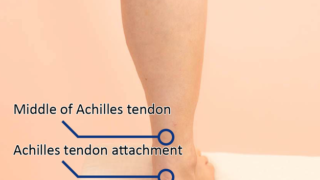
Achilles tendinitis tends to occur in one of two locations.
The first is very close to the heel bone, known as the Achilles tendon insertion. The second is in the middle portion of the Achilles tendon — approximately halfway between the calf and the heel, where the tendon is slightly constricted — referred to as the midportion of the Achilles tendon.
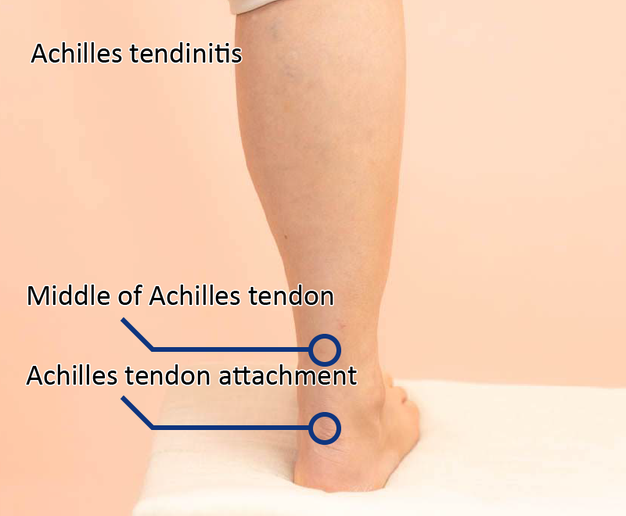
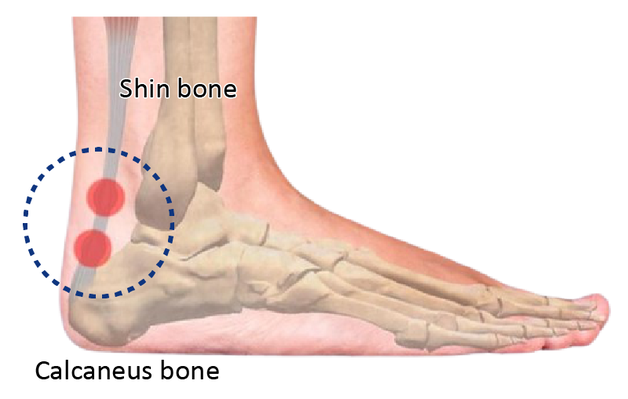
The appropriate treatment differs somewhat depending on which location is affected. For those who would like to know more, consultation at a specialized medical institution is recommended.
Q What are the symptoms of Achilles tendinitis, and how is it diagnosed?
Characteristic symptoms include pain around the heel during exercise, pain when standing on tiptoes, and pain in the heel when beginning to walk. Swelling of the Achilles tendon is also a common finding.
Diagnosis is confirmed through ultrasound examination, which allows rapid and accurate assessment of the affected area.
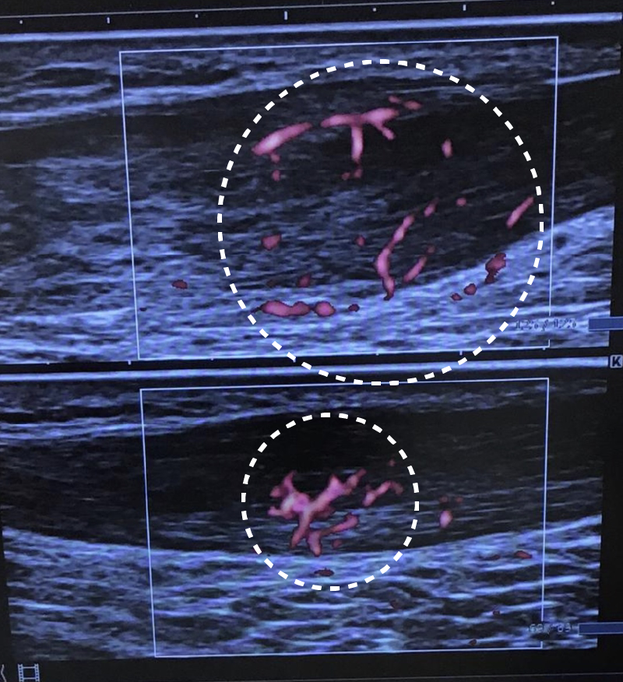
The image above shows an actual ultrasound of a patient with Achilles tendinitis. The inflamed and swollen areas are shown in red, indicating the source of pain.
Q What is the difference between Achilles tendinitis and peritendinitis?
Achilles tendinitis and Achilles peritendinitis refer to the same condition. The terms are simply different names used to describe the same underlying pathology.
Q How long does Achilles tendinitis usually take to heal?
Achilles tendinitis can be divided into mild and severe cases.
Mild cases can indeed resolve within approximately three weeks to two months. However, nearly half of patients continue to experience pain six months after symptom onset, and these individuals are classified as severe cases.
In severe Achilles tendinitis, it becomes difficult to predict when recovery will occur. Pain frequently persists beyond one year, and the condition often does not resolve with standard care alone. While rest is important to prevent further deterioration, patients who do not improve despite rest should seek evaluation at a specialized medical institution, where treatment can be directed at the underlying cause.
Q What causes Achilles tendinitis?
One of the main causes of Achilles tendinitis is repetitive strain. Running and training place repeated stress on the Achilles tendon, which can lead to the condition. Age is another contributing factor — after the age of 40, Achilles tendinitis can develop even without significant physical activity.
The underlying mechanism of Achilles tendinitis is believed to be the abnormal proliferation of blood vessels within the tendon. The human body responds to repetitive strain by forming new blood vessels, and this process is accelerated when intense training continues without adequate rest. Furthermore, after the age of 40, abnormal blood vessels can form even in the absence of physical load.
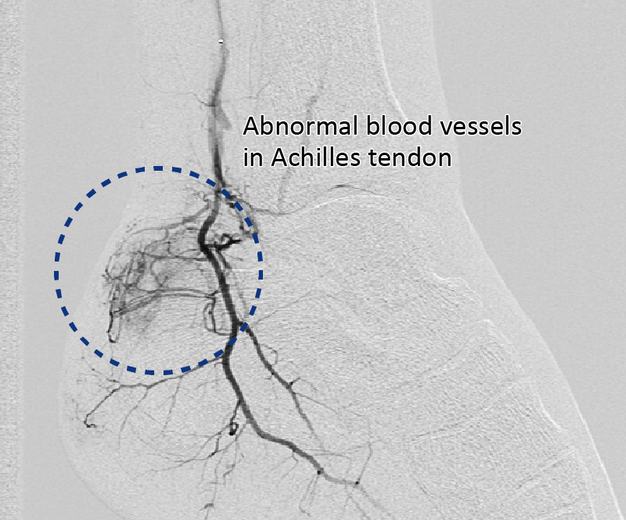
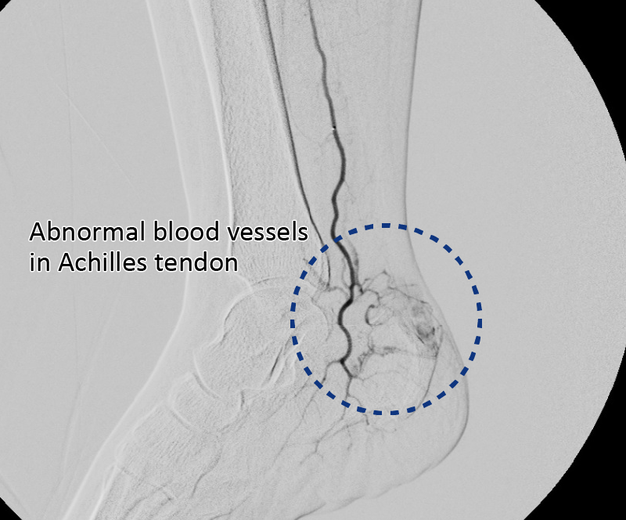
Because nerve fibers grow alongside blood vessels — a fundamental principle of the body's biology — this vessel proliferation gives rise to pain. For those interested in learning more about these abnormal blood vessels, please also refer to
Q It has been six months since I developed Achilles tendinitis and various treatments have not helped. Why is it not improving?
Mild Achilles tendinitis can resolve within a matter of weeks, but severe cases do not heal easily.
If symptoms are not improving despite stopping training and undergoing treatment, it is possible that the current treatment is not adequately targeting the underlying cause of the pain. As described above, the cause of pain in Achilles tendinitis is the abnormal blood vessels and the nerve fibers that proliferate alongside them. Unless treatment directly addresses this underlying cause, the pain will not resolve. After six months of symptoms, the condition is likely to be severe, and consultation with a specialized medical institution is strongly recommended.
Q Is there a risk of tendon rupture if I continue playing sports with Achilles tendinitis?
The risk of rupture depends largely on age.
In patients in their teens or twenties, the risk of rupture is not zero but is relatively low. In younger individuals, Achilles tendon rupture typically occurs when a sudden and intense force is applied to the tendon — a scenario more likely to occur in people who have no prior pain in the Achilles tendon and then exercise suddenly. When pain is already present on a regular basis, the body tends to naturally limit the load placed on the tendon during activity, which reduces the likelihood of rupture.
However, patients who have received steroid injections or extracorporeal shock wave therapy should be aware that these treatments can weaken the Achilles tendon, and repeated use increases the risk of rupture.
For patients in their late 40s or 50s, the risk of rupture is comparatively higher than in younger individuals. After the age of 45, the tendency to develop abnormal blood vessels increases. As these vessels proliferate within the Achilles tendon, they cause pain while simultaneously weakening the tissue — meaning that even the minor stresses of daily activity can potentially cause a rupture.
Ultrasound examination at a medical institution is the most important step for anyone concerned about the condition of their Achilles tendon. Those worried about the risk of rupture are encouraged to seek specialist evaluation.
Q Are injections effective for Achilles tendinitis?
The effectiveness of injections depends on the type of medication used.
Steroid injections have a strong anti-inflammatory effect but are not recommended for Achilles tendinitis. Injecting steroids into the Achilles tendon on multiple occasions can weaken the tendon and, in some cases, lead to rupture.
Hyaluronic acid injections do not carry the same risk of tendon weakening, but their effectiveness for this condition is limited.
In general, injections should not be pursued without careful consideration. Consultation with a specialized medical institution is strongly advised before proceeding with any injection therapy.
Q What stretches are effective for Achilles tendinitis?
An exercise known as eccentric stretching is effective for Achilles tendinitis. The method is as follows:
- Perform the exercise on a step or low footstool.
- Place the forefoot of the affected side on the edge of the step and slowly lower the heel downward.
- This will stretch the Achilles tendon and produce some pain. Continue the stretch within a tolerable level of discomfort for approximately 15 seconds.
- Perform 3 repetitions per set, for approximately 2 sets per day.
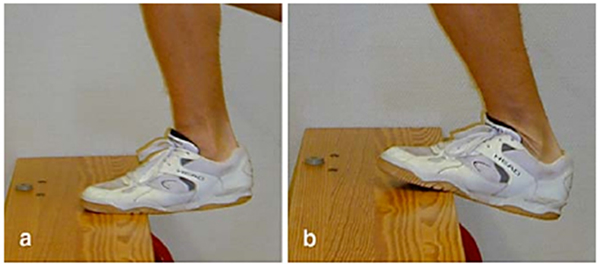
Although this stretch causes some pain during the exercise itself, research has shown that stretching the Achilles tendon in this way reduces blood supply to the abnormal vessels responsible for the condition, leading over time to a reduction in these vessels and an improvement in pain. Continue the stretch for at least two weeks.
Q My doctor has recommended extracorporeal shock wave therapy (ESWT). How effective is it for Achilles tendinitis?
Extracorporeal shock wave therapy is not strongly recommended for Achilles tendinitis. This treatment works by damaging nerve fibers to reduce the sensation of pain, but a certain proportion of patients find that it actually makes the condition more difficult to resolve. It can also cause tissue damage, increasing the risk of Achilles tendon rupture. These side effects have been reported in international medical literature, and patients are advised to discuss the treatment carefully with their physician before proceeding.
Q I have been to hospitals and clinics but my Achilles tendinitis has not improved. What further treatments are available?
For severe cases of Achilles tendinitis, catheter-based therapy is available. This treatment targets the abnormal blood vessels that are the underlying cause of pain, with the goal of achieving full recovery. For more details, please refer to the article:
Surgery is also an option, involving partial resection of the affected portion of the tendon. While removal of the painful tissue is expected to provide some benefit, surgical outcomes for this condition are generally not favorable, and residual pain or discomfort after surgery is not uncommon. Hospitalization is also required. For these reasons, surgery is not strongly recommended.
Author

-
I began my career as an interventional radiologist, which led to my research on pathological angiogenesis during graduate school. As first author, I published findings on related genes in Nature Medicine in 2012. Based on this work, I developed a novel embolization treatment for chronic musculoskeletal disorders, such as knee osteoarthritis and frozen shoulder, and was the first to report its safety and effectiveness. This approach is now being studied internationally.
-Career-
2006-2009 Fellow, Department of Radiology, Clinica ET, Yokohama, Japan
2009-2012 Researcher, Center for Integrated Medical Research, Keio University, Tokyo, Japan
2012-2015 Clinical Researcher, Department of interventional radiology, Edogawa Hospital, Tokyo, Japan
2015-2017 Director, Musculoskeletal Intervention Center, Edogawa Hospital, Tokyo, Japan
2017- Chief Director, Okuno Clinic., Tokyo, Japan
Latest posts
 Jun 7, 2026Vocal Cord Inflammation (Chronic Laryngitis) FAQ
 Jun 7, 2026Interstitial Cystitis FAQ
 Jun 7, 2026Plantar Fasciitis FAQ
 Jun 5, 2026Achilles Tendinitis FAQ