
Table of Contents
Q What is neck stiffness?
Neck stiffness is a condition in which the muscle groups supporting the head at the back of the neck become excessively tense, producing a range of uncomfortable sensations.
The discomfort associated with neck stiffness includes feelings of tightness, tension, fatigue, congestion, heaviness, and a sensation of something hard — like a steel plate — lodged in the neck. Pain may also accompany these sensations.
When the discomfort is severe, it can give rise to secondary symptoms such as headaches, nausea, vomiting, a feeling of heaviness in the head, heaviness around the eyes, dizziness, and pain in the nape of the neck. Excessive tension in the neck muscles can also reduce the range of motion in the neck, making it impossible to turn the head to the side or look back over the shoulder — causing a person to turn their entire body when responding to someone calling their name.
Although these symptoms can be highly distressing, neck stiffness has not traditionally been recognized as a medical disease, and for a long time there was no established specific treatment. As a result, the main approaches to managing the condition have been heat patches, acupuncture, moxibustion, massage, and pillow adjustment.
More recently, however, new treatments have emerged that specifically target the abnormal blood vessels that develop in the muscles and connective tissue of the neck. For more details, please continue reading further down this page.
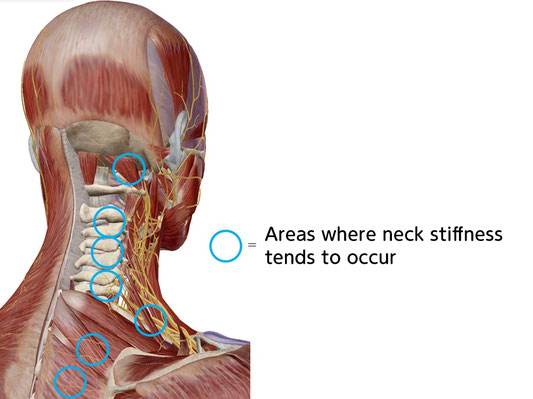
Q Can neck stiffness cause headaches and nausea?
Headaches and nausea can occur as a result of stiffness in the neck, shoulders, or nape. If these symptoms worsen alongside the neck stiffness, neck stiffness is likely the underlying cause.
Of course, headaches and nausea can also result from other medical conditions, so it is important to rule out other causes. However, if no other cause is identified and the symptoms consistently improve or worsen in conjunction with the neck stiffness, then neck stiffness is most likely responsible. In that case, treating the neck stiffness is essential to resolving the headaches and nausea at their root.
Q What causes neck stiffness?
Neck stiffness is not a single condition — it can be broadly divided into five types based on its underlying cause. One or more of these causes may be present in any given case.
The first cause involves significant one-time trauma to the area around the cervical vertebrae (the bones of the neck), such as whiplash from a traffic accident, a hard blow to the head, or direct impact to the neck. This type of injury can damage the tissues surrounding the cervical vertebrae, leading to chronic tightening of the surrounding muscles.
The second cause is repetitive strain on the neck resulting from poor posture — for example, working at a computer all day. As is often noted, the human head, including the skull and brain, weighs approximately as much as a bowling ball. The neck muscles continuously make fine adjustments to support this weight. When the head is held in a forward-jutting position for extended periods, the neck muscles must work constantly and excessively to compensate.
Consider the familiar image of an intoxicated person unable to control the weight of their own head, slumping forward, sideways, or backward while seated. In everyday life, the neck muscles unconsciously prevent this from happening at all times. During prolonged activities such as computer work or studying, this constant, unconscious muscular effort places sustained strain on the neck, resulting in stiffness and tightness.
The third cause is a change in physical constitution or hormonal balance. For example, significant changes in hormonal balance occur around the age of 40 or during menopause. These changes can increase muscle tension and trigger severe neck stiffness. Many people who had little or no awareness of neck stiffness in their younger years notice a marked worsening after reaching their 40s or 50s.
The fourth cause is age-related degeneration of the cervical vertebrae. Deformation of the vertebrae and their connecting joints can cause inflammation to spread to the surrounding muscles, resulting in stiffness.
The fifth cause is psychological stress, which is discussed in more detail in the following question.
The first four causes share an important commonality: injury, repetitive strain, hormonal changes, or structural degeneration can each trigger chronic inflammation in the body, which in turn leads to abnormalities in the local blood vessels. When abnormal blood vessels form in the muscles and connective tissue around the cervical vertebrae, nerves grow alongside them — and this combination is what drives the persistent discomfort and pain that characterizes difficult-to-treat neck stiffness.
In recent years, it has been found that treating these abnormal blood vessels can lead to meaningful improvement in neck stiffness. More details are provided later on this page.
Q Is there a connection between neck stiffness and stress?
There is a strong connection between neck stiffness and psychological stress, and several mechanisms explain this relationship.
First, psychological stress tends to bring on a low mood and a state of mild depression. It is known that when a person becomes depressed, changes in brain activity can give rise to pain or stiffness in the neck and back.
In fact, pain or stiffness in the area around the spine is recognized as one of the symptoms of clinical depression. Even during normal daily activity, very faint pain and stiffness signals originate from the neck and spine — but under ordinary circumstances, the brain filters these out as background noise (a function known in clinical terms as the descending inhibitory system). When stress intensifies and a person enters a depressed state, levels of serotonin and noradrenaline in the brain decrease, weakening this filtering mechanism. As a result, the brain becomes aware of sensations of stiffness and pain that it would previously have ignored.
A second mechanism is postural: when a person is under stress, the body tends to adopt a poor posture. Feeling low or anxious naturally causes people to hunch their shoulders and round their back — a posture that places additional strain on the neck muscles.
There is also an immune-related dimension. It is often said that laughter and enjoyment boost immunity — and indeed, positive emotional states help suppress inflammation in the body. Conversely, when a person is unable to relax or laugh, or is in a prolonged state of tension, immune function is weakened and the body becomes more susceptible to inflammation. For some people, this manifests as worsening skin conditions such as atopic dermatitis; for others, it may appear as gastrointestinal symptoms; and for others still, it can cause inflammation in the neck muscles and contribute to more severe neck stiffness.
Q What are the symptoms of neck stiffness?
The symptoms caused by neck stiffness are wide-ranging.
The most common are pain and discomfort in the nape of the neck, the back of the head, and the base of the neck. This discomfort may include sensations such as tightness, a feeling of something hard lodged inside the neck, a sensation like a steel plate, heaviness, and in some cases a crawling sensation. When attempting to turn the head to the side, movement may stop at a certain angle and the head cannot rotate further — making it necessary to turn the entire body when looking back in response to someone calling out.
Other symptoms include disturbed sleep due to discomfort, reduced range of motion in the neck, numbness and tingling from the shoulders through the arms and into the fingertips, muscle weakness, and decreased sensation in the arms and shoulders. Headaches, nausea, eye fatigue, a heavy sensation in the head, dizziness, general fatigue, and difficulty concentrating are also commonly associated with neck stiffness.
Q What stretches and exercises are recommended to relieve neck stiffness?
To reduce the burden on the neck, it is beneficial to stretch and exercise the back and lower back below the neck. Increasing flexibility in the thoracic and lumbar spine helps reduce the load on the cervical spine above.
Thoracic Spine Stretching
Sit on a chair and alternate between rounding and extending the back. Focus on pulling the solar plexus inward and then pushing it forward to create movement in the thoracic spine (the segment of the spine at the level of the solar plexus).
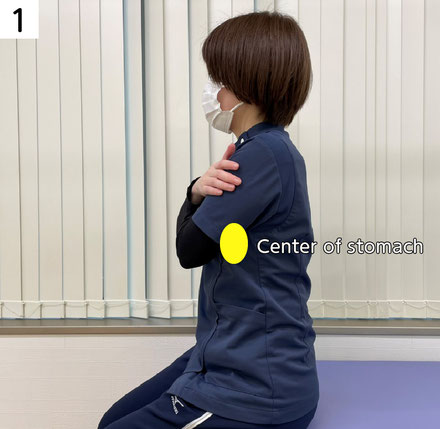
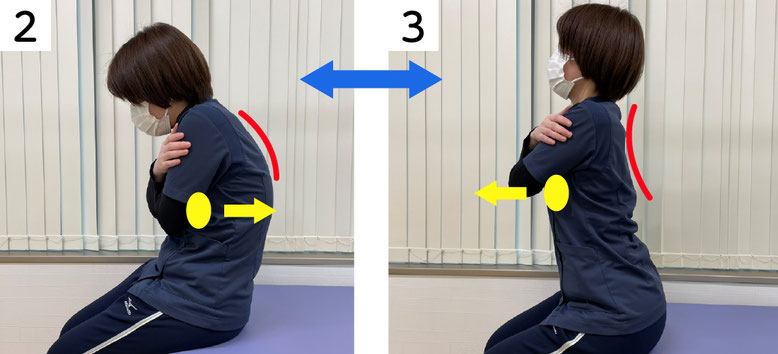
- Sit on a chair.
- Round the back, drawing the solar plexus backward.
- Extend the back, pushing the solar plexus forward.
- Repeat steps 2 and 3 slowly, 10 times.
Lumbar Spine Stretching
Lie on the back with both knees bent. Slowly roll both knees from side to side. During this movement, try to keep both shoulders flat on the floor to enhance the stretch sensation in the lumbar region.
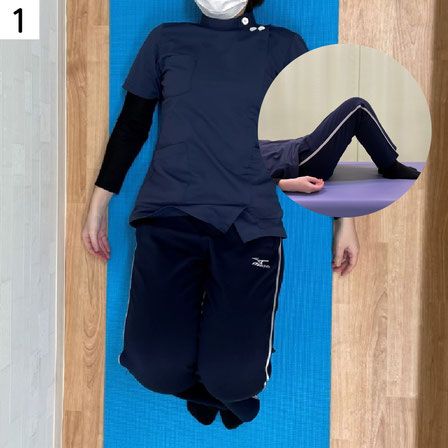
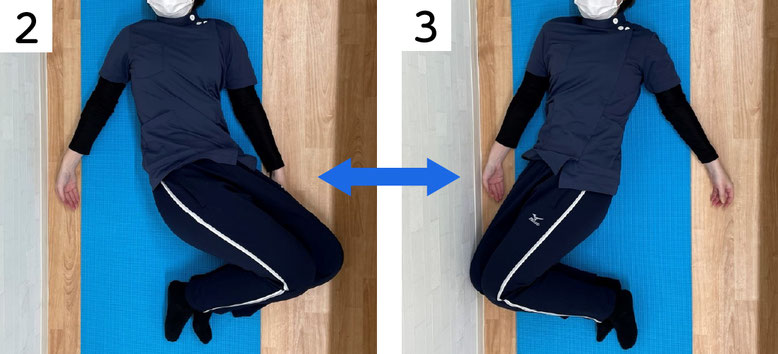
- Lie on the back with both knees bent.
- Keeping both knees bent, slowly roll them to the left.
- Then slowly roll them to the right.
- Repeat steps 2 and 3 slowly, 10 times.
Both stretches should be performed with slow, steady breathing, for approximately 10 repetitions each.
In addition, a posture in which the chin protrudes forward increases the load on the neck muscles and makes muscle tension more likely to develop. The following neck exercise is effective in reducing this strain.
Posture
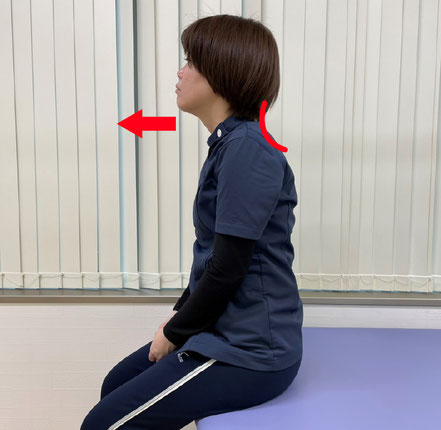
A forward chin posture;
→ increases load on the neck muscles
→ makes muscle tension more likely to develop.
Neck Exercise
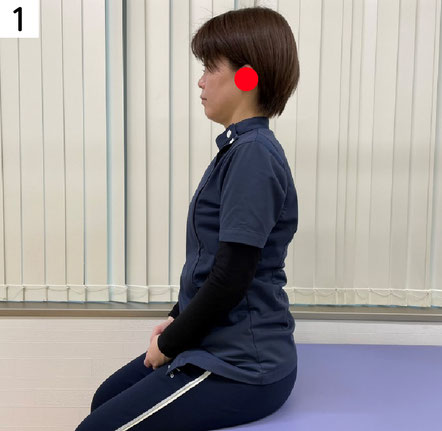
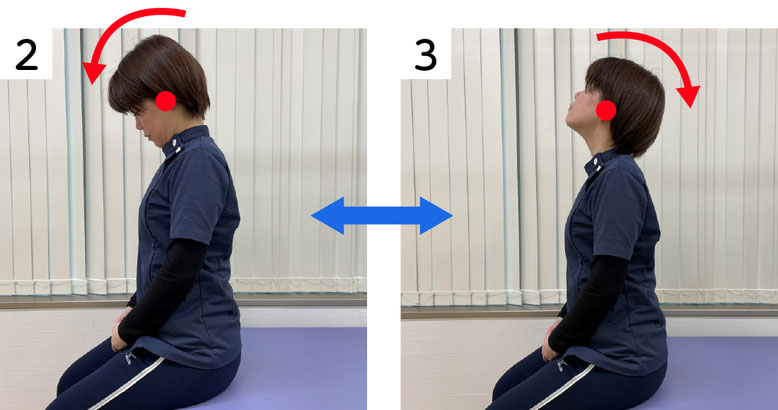
- Gently draw the chin back.
- Tilt the head downward, using the ear canal (marked with a red ●) as the axis of rotation.
- Tilt the head upward in the same manner as step 2.
- Slowly repeat steps 2 and 3, 10 times.
Q Are there any acupressure points or massage techniques for neck stiffness?
The following acupressure technique can help relieve neck stiffness. Locate the bony prominences on both sides at the base of the skull (the occipital ridge). Cup both hands around the back of the head so that the thumbs naturally rest against these points. From this position, apply slow, firm pressure — enough to feel a sensation that is pleasantly painful. Rather than rubbing, hold steady pressure for approximately 20 seconds.
Neck Acupressure / Massage 1
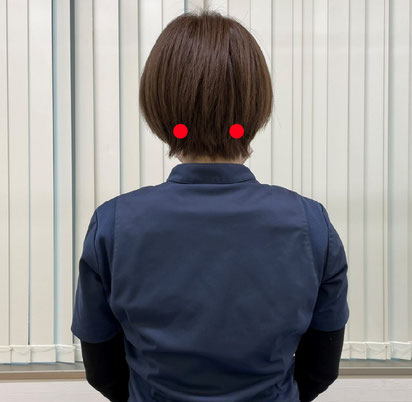
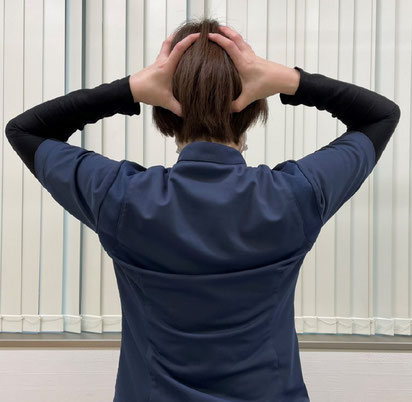
- Locate the bony prominences (marked with a red ●) just below the back of the head at the base of the skull.
- Cup both hands around the head so that the thumbs rest against the red ● points.
- Apply slow, steady pressure to a level that feels pleasantly firm — not sharply painful.
- Rather than rubbing, sustain the pressure for approximately 20 seconds.
Neck Acupressure / Massage 2
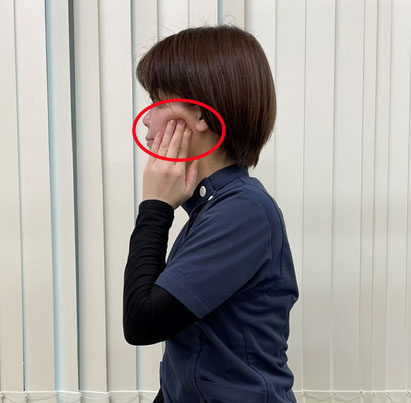
Jaw muscle (masseter) massage
Place the fingertips on the area that moves when opening and closing the mouth. Apply gentle pressure and massage softly.
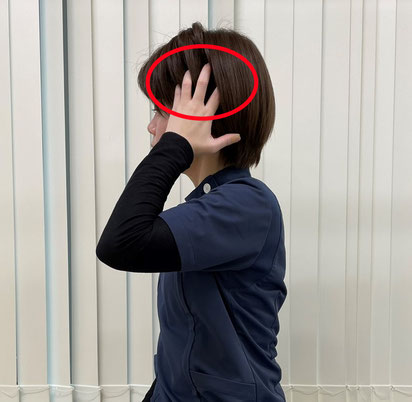
Temporal muscle massage
Place the fingertips on the area above and behind the ears. Apply gentle pressure and massage, imagining that the scalp itself is being moved.
Q Are there any products that can help with neck stiffness?
One of the most effective aids for neck stiffness is choosing the right pillow. A pillow of appropriate height, adjusted to the individual, is recommended.
The ideal pillow height varies depending on age and the condition of the cervical spine. A practical way to assess this is to lie on the back with both arms crossed over the chest, place the pillow under the head, and gently roll from side to side. The correct height is one that allows easy rolling without discomfort and without needing to push with the hands.
A convenient way to create a pillow of this ideal height is to fold a bath towel and adjust the layers until the right thickness is achieved.
Commercially available pillows with raised side sections, or those that are concave at the head and slightly raised at the neck, are not recommended. These designs make it difficult to change sleeping position and can place additional strain on the neck.
Q Should I apply cold or heat to a stiff neck?
Neither is generally recommended as a treatment for neck stiffness. Cooling or warming the neck often fails to resolve the underlying problem, and excessive application of either can overstimulate the area and increase sensitivity. The stretching exercises described above and acupressure applied to areas of discomfort are considered more appropriate approaches to self-care.
Q My neck stiffness temporarily improves with massage but keeps returning. Is there a way to treat it at its root cause?
Immediately after vigorous massage of the affected area, the brain temporarily releases substances in response to the physical stimulus — substances that reduce the perception of pain. This can create the impression that the pain and stiffness have improved, but the effect is only temporary. Once these substances diminish (which typically occurs within a few hours), the symptoms return to their previous level. Furthermore, strong massage can actually worsen inflammation in the neck and shoulders through excessive stimulation, potentially generating stronger pain signals in the hours that follow — a phenomenon known in Japanese as "momi-kaeshi" (post-massage soreness). For these reasons, vigorous massage is not recommended, as it does not address the underlying cause.
As described above, the root causes of neck stiffness — major trauma, repetitive strain, and hormonal imbalance — all share the common outcome of causing abnormal blood vessel formation near the cervical vertebrae. When these abnormal vessels develop in the muscles and connective tissue surrounding the neck bones, nerves proliferate alongside them, generating persistent discomfort and pain.
In recent years, a treatment has become available to safely reduce these abnormally formed blood vessels, and it has been shown to achieve meaningful improvement in long-standing neck stiffness symptoms.
For those interested in learning more about abnormal blood vessels, please also refer to
Author

-
I began my career as an interventional radiologist, which led to my research on pathological angiogenesis during graduate school. As first author, I published findings on related genes in Nature Medicine in 2012. Based on this work, I developed a novel embolization treatment for chronic musculoskeletal disorders, such as knee osteoarthritis and frozen shoulder, and was the first to report its safety and effectiveness. This approach is now being studied internationally.
-Career-
2006-2009 Fellow, Department of Radiology, Clinica ET, Yokohama, Japan
2009-2012 Researcher, Center for Integrated Medical Research, Keio University, Tokyo, Japan
2012-2015 Clinical Researcher, Department of interventional radiology, Edogawa Hospital, Tokyo, Japan
2015-2017 Director, Musculoskeletal Intervention Center, Edogawa Hospital, Tokyo, Japan
2017- Chief Director, Okuno Clinic., Tokyo, Japan
Latest posts
 Jun 7, 2026Vocal Cord Inflammation (Chronic Laryngitis) FAQ
 Jun 7, 2026Interstitial Cystitis FAQ
 Jun 7, 2026Plantar Fasciitis FAQ
 Jun 5, 2026Achilles Tendinitis FAQ